Custom Website vs. Template for Small Business: What to Know
Every small business owner building a website faces the same fork in the road: start with a template and get online fast, or invest in something built from scratch for your brand? It sounds like a simple question, but the answer has real consequences for how your site performs, how you rank on Google, and whether your website actually brings in customers. Understanding the differences in the debate over custom website vs. template for small business is the starting point for making the right call. At Indy Blitz, we’ve been building custom websites for Indianapolis-area businesses since 2009 — and we’ve helped clients navigate this decision more times than we can count. Here’s an honest look at both options.
Both Options Get You Online — But They Don’t Deliver the Same Results
A template and a custom website will both put your business on the internet. That’s where the similarities largely end. The way each one is built determines how well it performs in search engines, how distinctively it represents your brand, how easily it scales as your business grows, and how effectively it converts visitors into paying customers.
The decision isn’t really about which option is objectively “better.” It’s about which one is right for where your business is today and where you’re trying to take it. To make that call, you need to understand what each actually delivers — and what it doesn’t.
What Template Websites Actually Give You
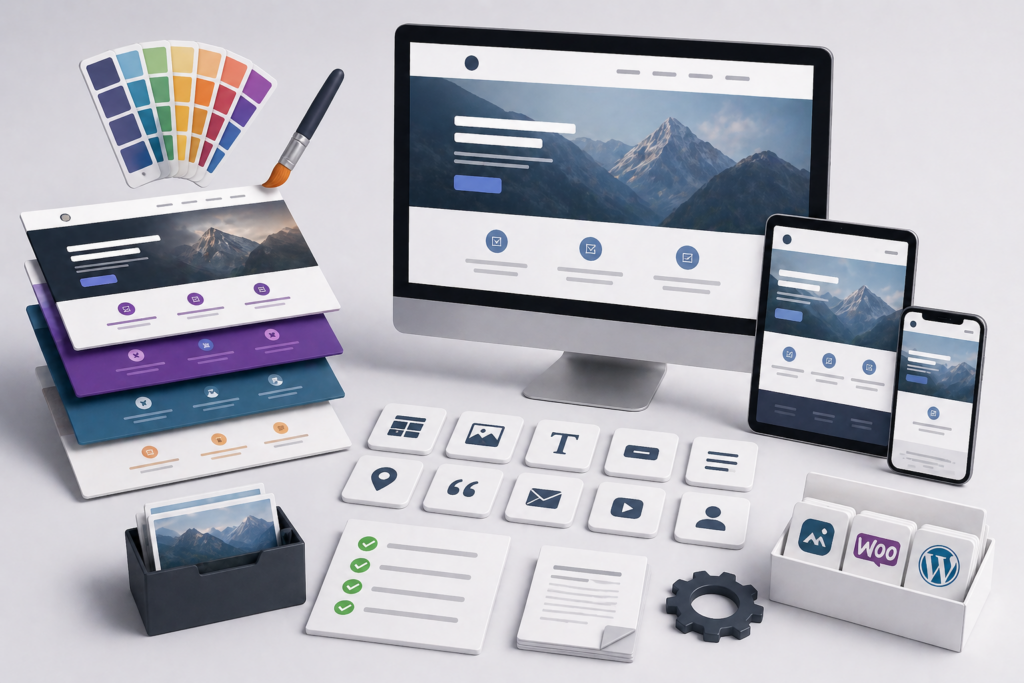
A template website is a pre-designed layout — built by a third party and sold or offered on platforms like WordPress, Squarespace, Wix, or Shopify. You select a design, swap in your content, adjust colors and fonts, and launch. It’s the fastest and most affordable way to get a professional-looking site up and running.
Templates have real strengths, and for certain businesses and situations, they’re a perfectly reasonable choice:
- Low upfront cost — Template-based sites typically cost between $500 and $3,000 to set up, making them accessible for businesses with very limited startup budgets.
- Fast launch time — A template site can go live in days, sometimes hours. If you need an online presence immediately, nothing is faster.
- No coding required — Most modern template platforms use drag-and-drop editors that anyone can use without technical knowledge.
- Pre-built features — Contact forms, image galleries, basic e-commerce, and blog functionality are often included out of the box.
But templates also carry limitations that become more significant the longer your business depends on the site to grow:
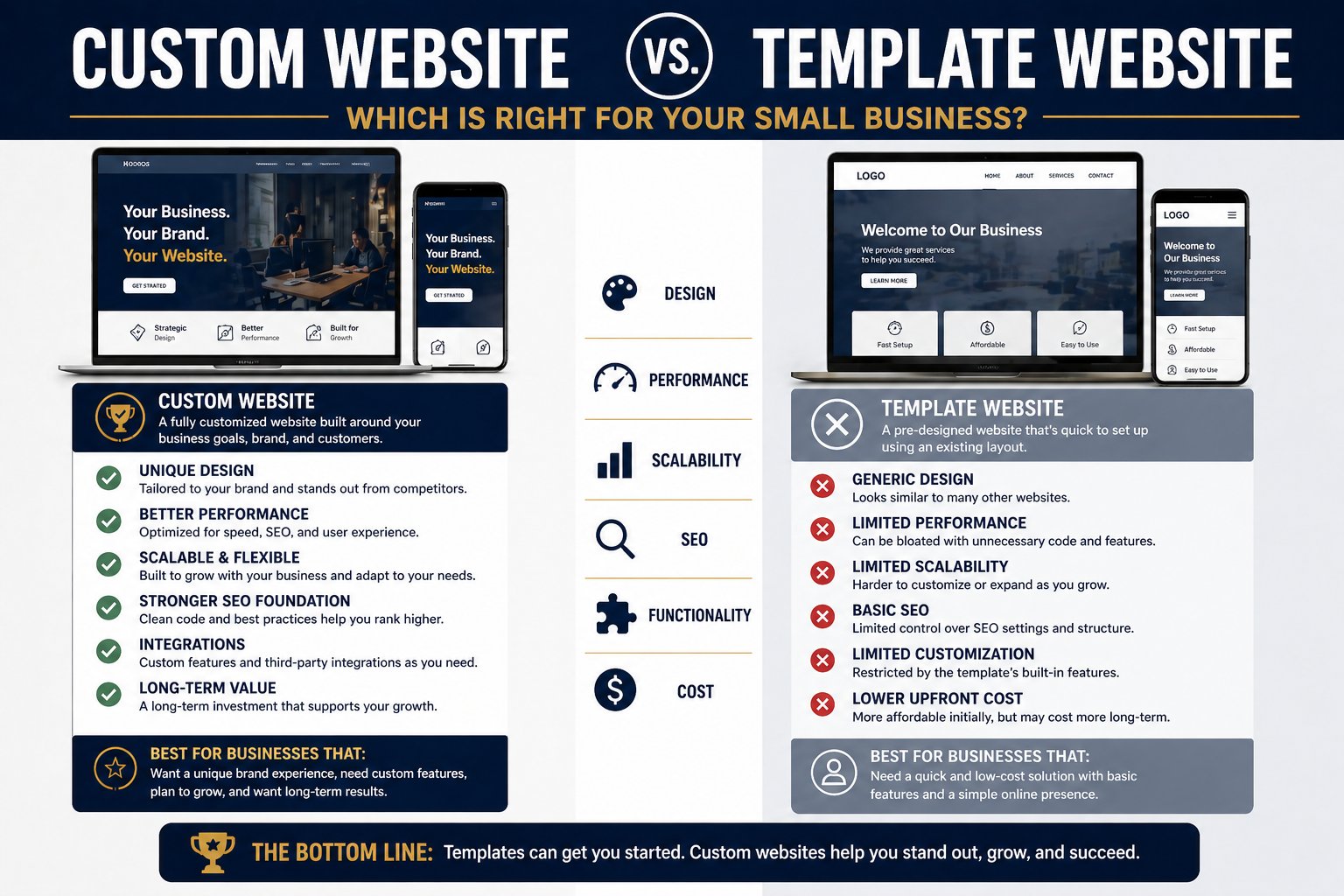
- You can’t stand out — The same template is sold to thousands of businesses across every industry. Your competitor two miles away could be running the same design with different colors. In competitive local markets like Indianapolis, looking generic is a real disadvantage.
- Customization hits a wall — Templates are built to accommodate as many businesses as possible, which means they’re designed for the average use case — not yours specifically. When you need to modify layout, add custom functionality, or restructure navigation, you often can’t — or it requires expensive developer workarounds.
- Performance suffers from code bloat — Templates include features and code for every possible user, most of which your site doesn’t need. This extra weight slows down load times — and page speed is both a Google ranking factor and a direct driver of whether visitors stay on your site or leave.
- SEO has a ceiling — Most templates are marketed as “SEO-friendly,” which typically means they cover the basics. Deeper technical SEO — clean code structure, custom schema markup, optimized page architecture — is much harder to achieve within a template’s constraints.
- You’re dependent on the template developer — If the company that built your theme stops maintaining it, your site can become incompatible with new web standards or vulnerable to security issues, leaving you with a rebuild on your hands anyway.
What a Custom Website Gives You That a Template Simply Can’t
A custom website is built from scratch around your business — your brand, your customers, your goals, and your growth trajectory. Every element is intentional. Nothing is carried over from a design built for someone else’s business in a different industry.
For businesses that are serious about using their website as a real growth tool — not just an online brochure — here’s what a custom build delivers:
- A brand identity that’s genuinely yours — Custom design reflects your business specifically: your colors, your voice, your visual style. It builds recognition and communicates professionalism in a way that a tweaked template cannot replicate.
- Conversion-focused architecture — A custom site is designed around your customer’s journey, not a generic one. The navigation, layout, calls to action, and page flow are structured to move visitors toward the actions that matter to your business — whether that’s calling, booking, buying, or signing up.
- Faster performance — Custom builds include only what your site actually needs. No unused plugins, no redundant scripts, no bloat. Lean code loads faster — which improves both user experience and Google rankings.
- Stronger technical SEO foundation — When a site is built correctly from the ground up, it gives developers control over every technical SEO element: code structure, page speed optimization, schema markup, mobile-first design, and crawlability. These foundational advantages compound over time.
- Scalability built in — As your business grows, your custom site grows with it. Need to add a service area, integrate booking software, connect a CRM, or build out an e-commerce function? A properly built custom site accommodates these additions without requiring a full rebuild.
- Full ownership and independence — You own the code. You’re not dependent on a third-party template company’s decisions about updates, pricing, or discontinuation. That independence protects your investment long-term.
How Do the Costs Actually Compare?
Cost is where most small business owners focus first — and it’s a fair place to start, as long as the comparison includes the full picture rather than just the upfront number.
| Factor | Template Website | Custom Website |
|---|---|---|
| Upfront cost | $500 – $3,000 | $4,000 – $12,000+ (small business) |
| Launch timeline | Days to 1–2 weeks | 4–8 weeks typically |
| Ongoing costs | Plugin licenses, theme renewals, future redesigns | Maintenance and hosting; fewer unplanned costs |
| SEO performance | Basic; ceiling on technical optimization | Full control; built for search from the ground up |
| Conversion performance | Generic user flows; not built for your audience | Designed around your customer journey |
| Lifespan before rebuild | Often 2–4 years as business needs outgrow it | 5–8+ years with proper maintenance |
| Long-term ROI | Lower — limited growth ceiling | Higher — designed to generate and scale returns |
The template looks cheaper at first glance. But when you factor in the cost of a redesign in two or three years when you’ve outgrown it, the ongoing plugin fees, and the lost revenue from weaker SEO and conversion performance, the gap between the two options narrows significantly — and often reverses over a 3-to-5-year horizon.
Which Option Is Right for Your Business Right Now?
There isn’t a universal answer — the right choice depends on where your business is and what you need from your website. Here’s a straightforward framework for thinking it through:
A Template Makes Sense If…
- You’re just starting out and need an online presence with a very limited budget
- Your website’s primary function is informational — a simple digital business card with your services, hours, and contact details
- You need to launch within days for a time-sensitive reason
- Your industry is not highly competitive locally, and differentiation is less critical
A Custom Website Makes Sense If…
- Your website is a primary channel for generating leads, appointments, or sales — and its performance directly affects your revenue
- You operate in a competitive local market like Indianapolis where standing out from similar businesses matters
- You plan to invest in SEO and want a technical foundation that will actually support those efforts
- Your business is growing and your site needs to grow with it — adding pages, service areas, integrations, or functionality over time
- Your brand identity is important and you want a site that genuinely represents who you are, not a layout used by hundreds of other companies
At Indy Blitz, we’re honest with every business we talk to about this. Some clients come to us and genuinely just need a simple, clean presence online — and we’ll tell them that. But for most small businesses in Indianapolis and across Central Indiana that want their website to actually drive growth, a custom build is the investment that pays off. We’ve been doing this since 2009, and we’ve seen the difference in real results.
If you’re unsure which direction makes sense for your business, call us at (317) 653-6567 or reach out through our contact page. We’re happy to have an honest conversation about your goals and tell you straight what we think — no pressure, no pitch.
Frequently Asked Questions: Custom Website vs. Template
Can I start with a template and upgrade to a custom website later?
Yes, and it’s a reasonable approach for businesses that are just getting started with very limited budgets. The important thing to understand is that migrating from a template to a custom site isn’t a simple upgrade — it’s effectively a rebuild. Content can be carried over, but the design, code, and structure start fresh. Many businesses find that by the time they’re ready to upgrade, they’ve also accumulated SEO issues from the template site that need to be cleaned up. Starting custom from the beginning avoids that double cost.
Are template websites bad for SEO?
Not inherently — a well-configured template site can perform reasonably well for basic SEO. The limitations show up at the technical level: template code is often heavier and slower than custom builds, deep structural SEO optimizations are harder to implement, and you’re constrained by what the template allows. For businesses competing seriously in local search, these constraints add up over time. A custom site gives your SEO agency or in-house team full control over every technical element from day one.
How long does a custom website take to build?
For most small business custom websites, the design and development process takes between four and eight weeks from kickoff to launch. The timeline depends on the scope of the project, how quickly content and feedback are provided by the client, and the number of revision rounds. At Indy Blitz, we set clear project timelines upfront and communicate at every phase so clients always know where things stand.
What does a custom small business website typically cost in Indianapolis?
For a professional custom website for a small business — typically five to fifteen pages with standard functionality — expect to invest in the range of $4,000 to $10,000 depending on complexity, integrations, and the scope of the project. E-commerce functionality, custom booking systems, or advanced features will add to that range. We offer competitive pricing and transparent quotes so there are no surprises mid-project.
Do I need a developer to maintain a custom website after it launches?
For day-to-day content updates — adding blog posts, editing service descriptions, swapping photos — most custom sites built on platforms like WordPress can be managed by the business owner without technical knowledge. For software updates, security patches, plugin management, and more significant changes, having a developer or a maintenance plan in place is advisable. Indy Blitz offers ongoing website maintenance packages for clients who want that support handled for them.